Calculators
Moles & Stoichiometry
Molar Mass
Molar mass of any formula, including hydrates, with a per-element breakdown.
M = Σ (atoms × atomic mass)
Moles & StoichiometryStoichiometry
Convert between two substances in a balanced equation via the mole ratio.
mole-ratio bridge
Moles & StoichiometryLimiting Reagent
Find the limiting reagent, theoretical yield and percent yield.
theoretical & % yield
SolutionsMolarity
Solve for concentration, moles or volume — with a grams ↔ moles helper.
M = n ÷ V
SolutionsDilution
Find stock volume, final volume or concentration when diluting.
M₁V₁ = M₂V₂
Acid-BasepH & pOH
Convert between [H⁺], [OH⁻], pH and pOH, or find a strong acid/base pH.
pH = −log[H⁺]
Gases & ThermoIdeal Gas Law
Solve for pressure, volume, moles or temperature, with unit choices.
PV = nRT
Gases & ThermoCombined Gas Law
Solve P₁V₁/T₁ = P₂V₂/T₂ for any of the six variables.
P₁V₁/T₁ = P₂V₂/T₂
Gases & ThermoCalorimetry
Solve for heat, mass, specific heat or temperature change.
q = mcΔT
Atomic StructureAtomic Notation
Protons, neutrons and electrons from element, mass number and charge.
N = A − Z
Atomic StructureAverage Atomic Mass
Weighted average atomic mass from isotope masses and abundances.
Σ (fraction × mass)
ReferenceSignificant Figures
Count significant figures and round to sig figs or decimal places.
Count & round
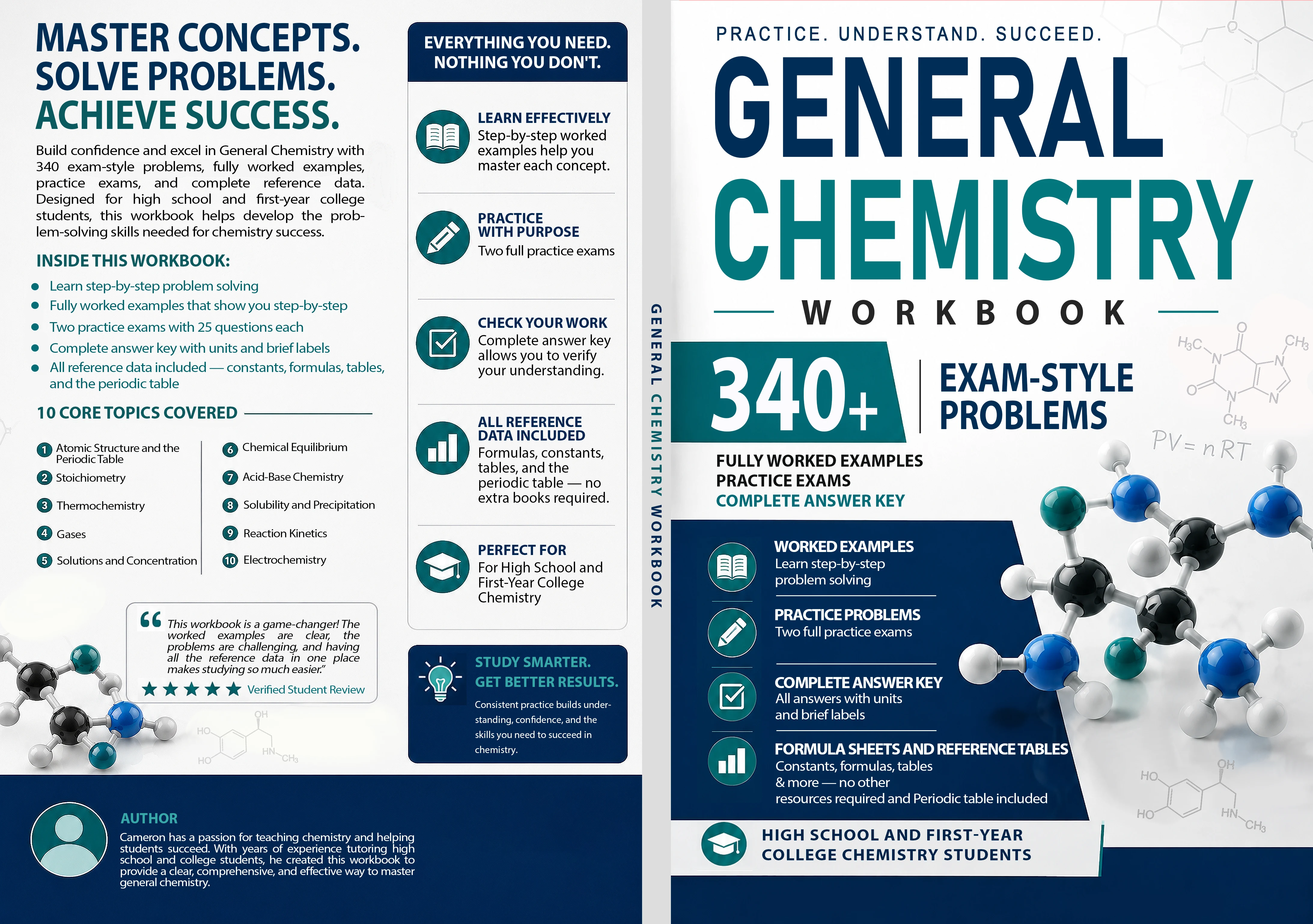
Want guided practice? Get the full workbook.
The General Chemistry Workbook pairs these calculators with 400+ exam-style problems, fully worked examples, two practice exams and a complete answer key — with every constant and reference table embedded.
View on Amazon →Built for students
GenChemCalc covers the ten core topics of a first general chemistry course: atomic structure, stoichiometry, thermochemistry, gases, solutions, equilibrium, acid-base chemistry, solubility, kinetics and electrochemistry. More calculators are being added — see the guides for plain-language explanations of the concepts behind each tool, and the methodology page for the sources and standards used.